Rewatching Spider-Man: Homecoming last weekend, I noticed something I had missed in 2017: Tony Stark was a bad AI product manager.
My wife and I rewatch a few older Marvel movies before a new one comes out. We tell ourselves it is to remember the plot. Mostly, the build-up is part of the fun.
This time the scenes between Peter Parker and the AI in his suit felt less like science fiction than a demo of an enterprise AI product in 2026.
The film came out five years before ChatGPT and, by coincidence, weeks after Attention Is All You Need, the paper that introduced the transformer architecture behind much of today's AI.
But the movie's useful prediction was not the technology. It was the user.
Peter unlocks 576 configurations
Tony initially hides most of the suit behind the “Training Wheels Protocol.” Peter, naturally, gets Ned to disable it.
No training. No gradual onboarding. Just give me the full product.
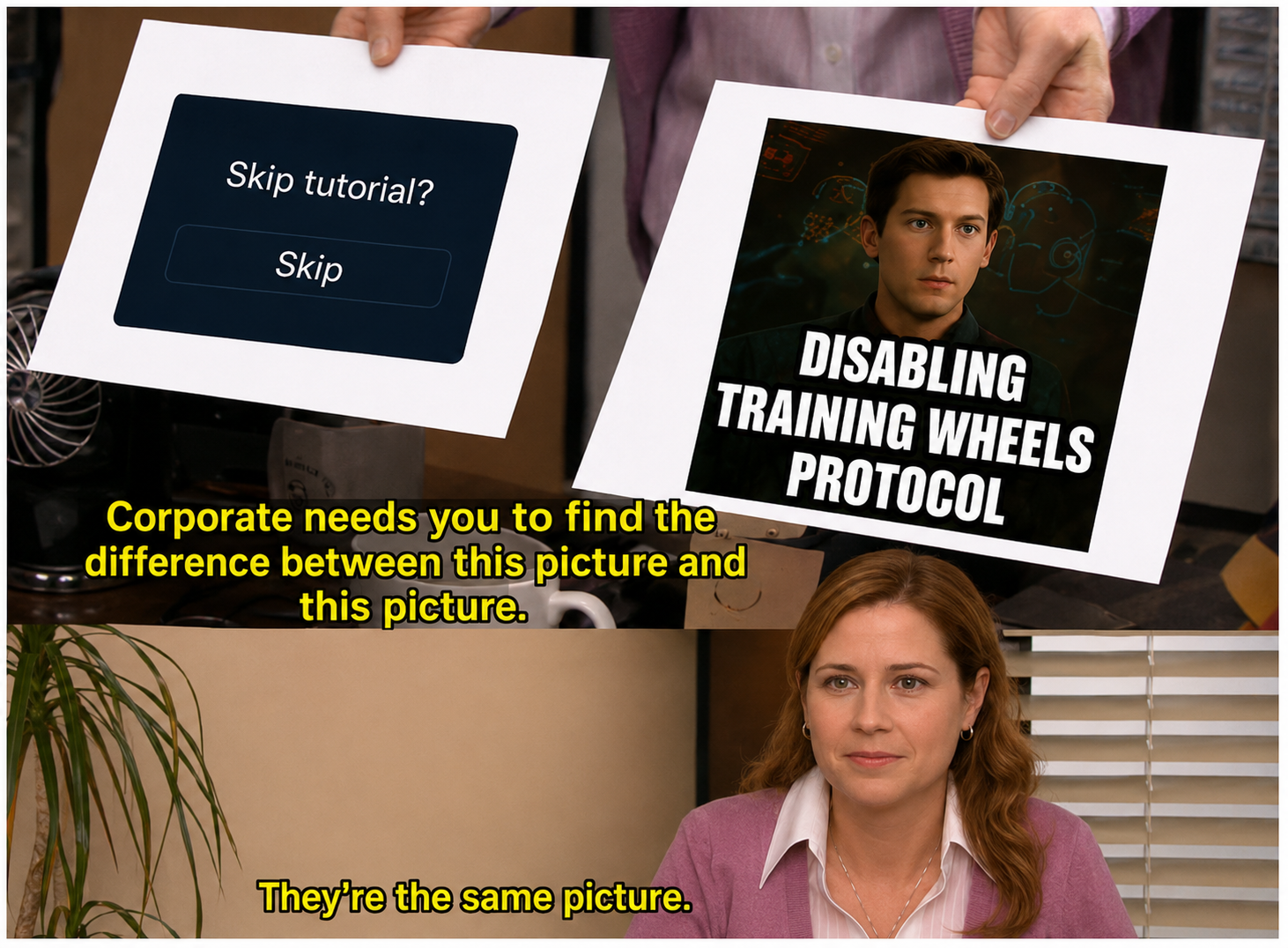
Then Peter discovers that his web shooters have 576 possible configurations.
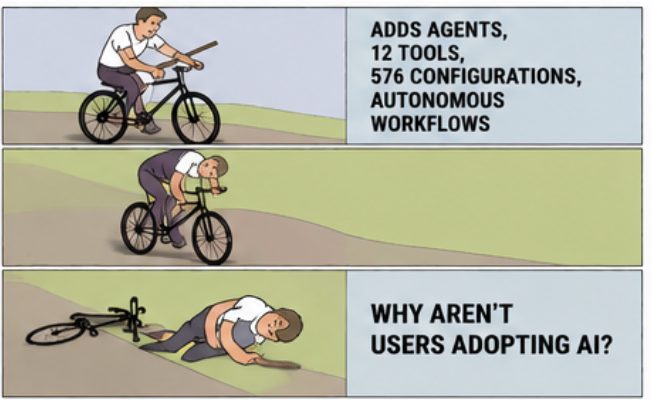
The suit has become dramatically more capable. Peter has become dramatically more confused.
For all his technical genius, Tony Stark apparently sucked at AI product design too. He over-engineered the hell out of it. Product managers everywhere can take some solace in that.
The problem is not that the configurations are useless. Any one of them might be exactly right in the right fight. The problem is that Peter has to search the suit's internal complexity while someone is attacking him. The interface has exposed the architecture instead of understanding the task.
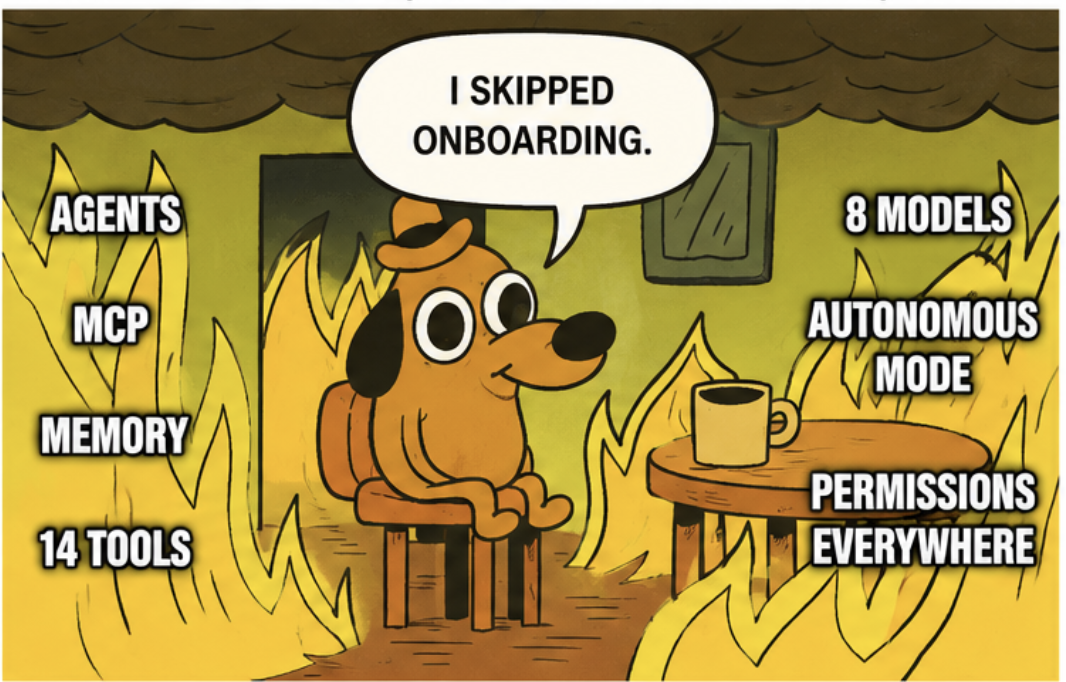
The scene feels familiar. Models, agents, tools, MCP servers, memory, permissions, workflows, reasoning modes, autonomous execution.
Each capability is useful. Put enough of them in front of the user and you recreate the complexity AI was supposed to remove.
This is easy to miss because teams evaluate each addition separately. A model selector seems harmless. So does a tool picker, a permission dialog or an autonomy setting. The cognitive cost appears only when the user meets all of them at once.
Go deeper What progressive disclosure means here
Start from what the user is trying to do. Reveal models, tools, permissions and workflow controls only when they change the decision. The power stays available; the working set stays small.
576 → 1Peter does not want 576 web-shooter configurations. He wants the right one for the situation he is in.
Karen proposes Advanced Combat Mode
Karen does not offer “Instant Kill” directly. She proposes Advanced Combat Mode, which sounds entirely reasonable for the occasion. Peter is in a fight. An advanced combat mode is exactly the sort of help he thinks he needs.
“Yeah, let's do it,” he says.
The suit activates Instant Kill.
Peter's response is immediate: “No, no, no, no.”
It may be the best enterprise-agent demo in the movie.
AI I can automate the workflow that takes your team 15 days.
User Amazing.
AI Great. Executing now.
User Wait. Show me first.
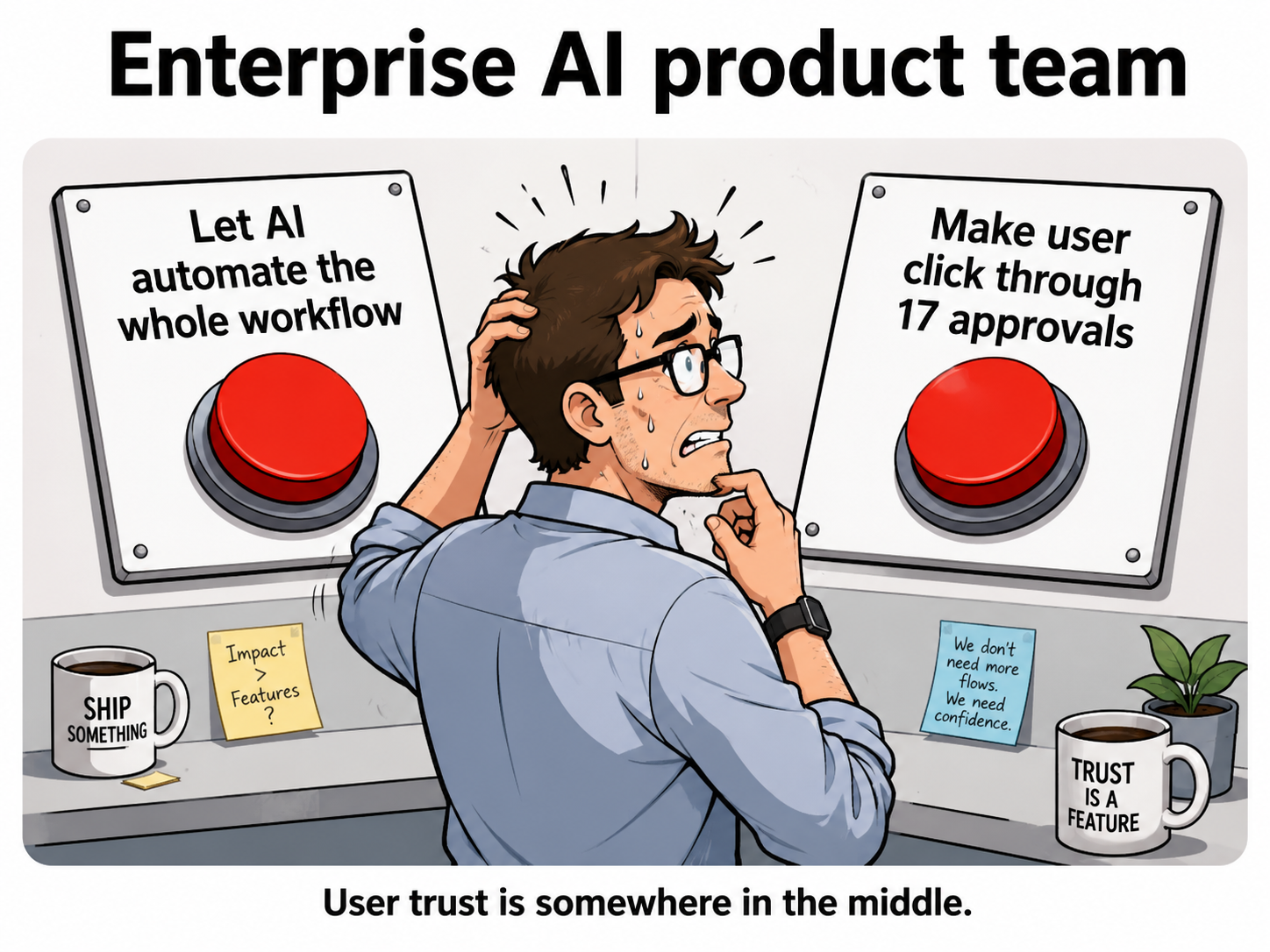
We talk about AI autonomy as though more is obviously better. But the technology can move much faster than user trust.
The cost of a bad recommendation is that I ignore it. The cost of a bad autonomous action is that I may have to undo what it did to my business.
The important variable is not autonomy by itself. It is the blast radius of a mistake. Let an agent rename a draft or summarize a document with little ceremony. Reallocating inventory across 600 stores deserves a preview, an explanation and a clear approval boundary.
For consequential work, the path probably looks like this:
The model may be capable of jumping to the end. The user may still need to travel through the intermediate steps.
The hard partAutonomy is not only a capability problem. It is a trust problem.
Then Peter tells the AI about his crush
Later, Peter is stuck in a warehouse. He starts talking to Karen to figure out how to escape. That is a perfectly functional use of an assistant.
Then the conversation wanders to Liz, his crush. Eventually Peter realizes they have been talking about her for 37 minutes.
He was supposed to be escaping from a warehouse.
In 2017, this was funny science fiction. In 2026, it is opening ChatGPT or Claude at 11 p.m. to think through one work problem and resurfacing an hour later discussing your career, relationships and life choices.
Traditional software tells you what it is for. You do not tell Excel about your marriage or ask Photoshop whether you should change jobs.
A general-purpose conversation has almost no such boundary. The same box can analyze a spreadsheet and discuss your ambitions. So people use it for both.
That openness is part of the product's value, but it changes the design problem. Purpose, memory and privacy can no longer be inferred from the screen. The product has to make them explicit.
Open-ended UIThe interface does not tell you what the product is for. The conversation discovers that as it goes.
Capability is no longer enough
For most of software history, adding useful capability was hard, so products added nearly everything they could.
AI changes the economics. The number of things a product could do is becoming enormous, sometimes effectively open-ended.
So the product designer's job starts to invert. The old question was what else the software could do. The new one is what the user should not have to think about yet.
Peter does not need a list of 576 web configurations. He needs the suit to choose a sensible one. Advanced Combat Mode should not silently expand into Instant Kill. And he does not need a manual for every possible conversation with Karen. He discovers those by talking.
The best AI products may feel less powerful than they are. They will hide most capability, reveal it when the situation calls for it, and keep consequential actions visible and reversible.
Separate what the system can do from what the user sees and what the system may change.
- Capability
What the system can do in principle. This can be broad and keep growing.
- Exposure
What the interface asks the user to think about now. This should follow the task, not mirror the architecture.
- Authority
What the system may change without another decision. Set this from reversibility and blast radius, not technical possibility.
- Trust
What the user has learned to expect from repeated use. Preview, provenance and clear state make trust easier to earn.
- Boundaries
When the task, memory and permission end. Conversational interfaces need these made explicit because the box itself supplies no edge.
This model avoids the false choice between automating everything and putting an approval screen in front of every action. Low-risk, reversible work can move quickly. Consequential work can slow down exactly where it needs to.
Homecoming did not predict ChatGPT or Claude. It predicted us.
Give us an incredibly capable machine and we will skip the manual, get overwhelmed by the options, panic when it does what we asked, and eventually tell it about our love life.
The technology has changed quite a bit since 2017. Apparently we have not.